IPA 70% vs 99%: Which Concentration Does Your Job Need?
The number on the bottle — 70%, 91% or 99% — is the percentage of isopropyl alcohol (IPA) by volume; the rest is water. And the water is not a filler. It decides what the product does. At 70%, the water slows evaporation, so the alcohol stays on the surface long enough to penetrate microbial cell walls and denature their proteins — which is why 70% is the better disinfectant and the concentration the CDC and WHO recommend for surface disinfection. At 99%, the alcohol flashes off almost instantly and leaves essentially no residue, which is exactly what electronics cleaning, PCB defluxing and precision optics need. Buy the concentration for the job, not the biggest number: if you are killing germs, reach for 70%; if you are cleaning a circuit board, reach for 99%.
Key Findings
- 70% IPA disinfects better than 99%. The water in a 70% solution slows evaporation, giving the alcohol longer contact time to penetrate cell walls and denature proteins. 99% evaporates too fast and can coagulate surface proteins into a protective barrier. 70% is the concentration the CDC and WHO recommend for surface disinfection.
- 99% IPA is the electronics and precision-cleaning solvent. It evaporates almost instantly and leaves essentially no residue — critical for PCB defluxing, precision optics, 3D printing and lab cleaning, where water damages components or leaves spots.
- 91% is the retail default, not an industrial optimum. It is the most common concentration sold in shops, and it comes from the IPA–water azeotrope (91% by volume). Most industrial buyers are better served by 70% for disinfection or 99% for cleaning.
- Concentration and grade are two different choices. 99% is not automatically USP grade. Technical, USP, ACS and electronic grades are separate specifications with their own purity limits and documentation — a 99% assay alone does not confer them.
- Yuandafeng sells IPA 99.9%. For disinfection, dilute it with purified water to about 70% (7 parts 99.9% IPA to 3 parts purified water, verified with a hydrometer or refractometer) or buy 70% ready-made. For electronics and precision cleaning, use the 99.9% straight.
Table 1 — 70% vs 91% vs 99% IPA
| Item | 70% IPA | 91% IPA | 99% IPA |
|---|---|---|---|
| Water content | 30% | 9% | 1% |
| Disinfection | Best — CDC/WHO recommended for surfaces | Good | Weaker — evaporates too fast |
| Evaporation | Moderate — seconds to a minute to dry | Fast | Almost instant |
| Residue left behind | Some water; may need wiping | Minimal | Essentially none |
| Best for | Surface disinfection, skin prep, healthcare, food processing, cleanrooms | General-purpose cleaning; most common retail concentration | Electronics, PCB defluxing, precision optics, 3D printing, thermal paste removal, lab cleaning |
| Typical buyer | Hospitals, clinics, food plants, pharma manufacturing areas | Households, general users | Electronics manufacturers, labs, precision cleaning |
Sources: Texas-Chem IPA grades guide; RightPath IPA grades guide; Azlok IPA guide.
Table 2 — IPA grades: concentration is not the grade
| Grade | What it means | Who needs it |
|---|---|---|
| Technical / industrial | Meets general commercial specifications; ships with SDS and spec sheet | General industrial cleaning, degreasing, manufacturing |
| USP | Meets the United States Pharmacopeia monograph; ships with a Certificate of Analysis | Pharmaceutical, diagnostic and personal-care use; regulated supply chains |
| ACS | Meets American Chemical Society reagent specifications; lot-verified against a COA | Analytical labs, QC, HPLC and UV-Vis work |
| Electronic / high-purity | Very low non-volatile residue and trace impurities | Electronics, semiconductors, precision optics |
A grade is a specification with its own impurity limits and documentation. A 99% assay does not make a product USP or ACS grade, and a 70% solution can be USP grade if it meets the monograph.
Figure 1 — Water content by IPA concentration
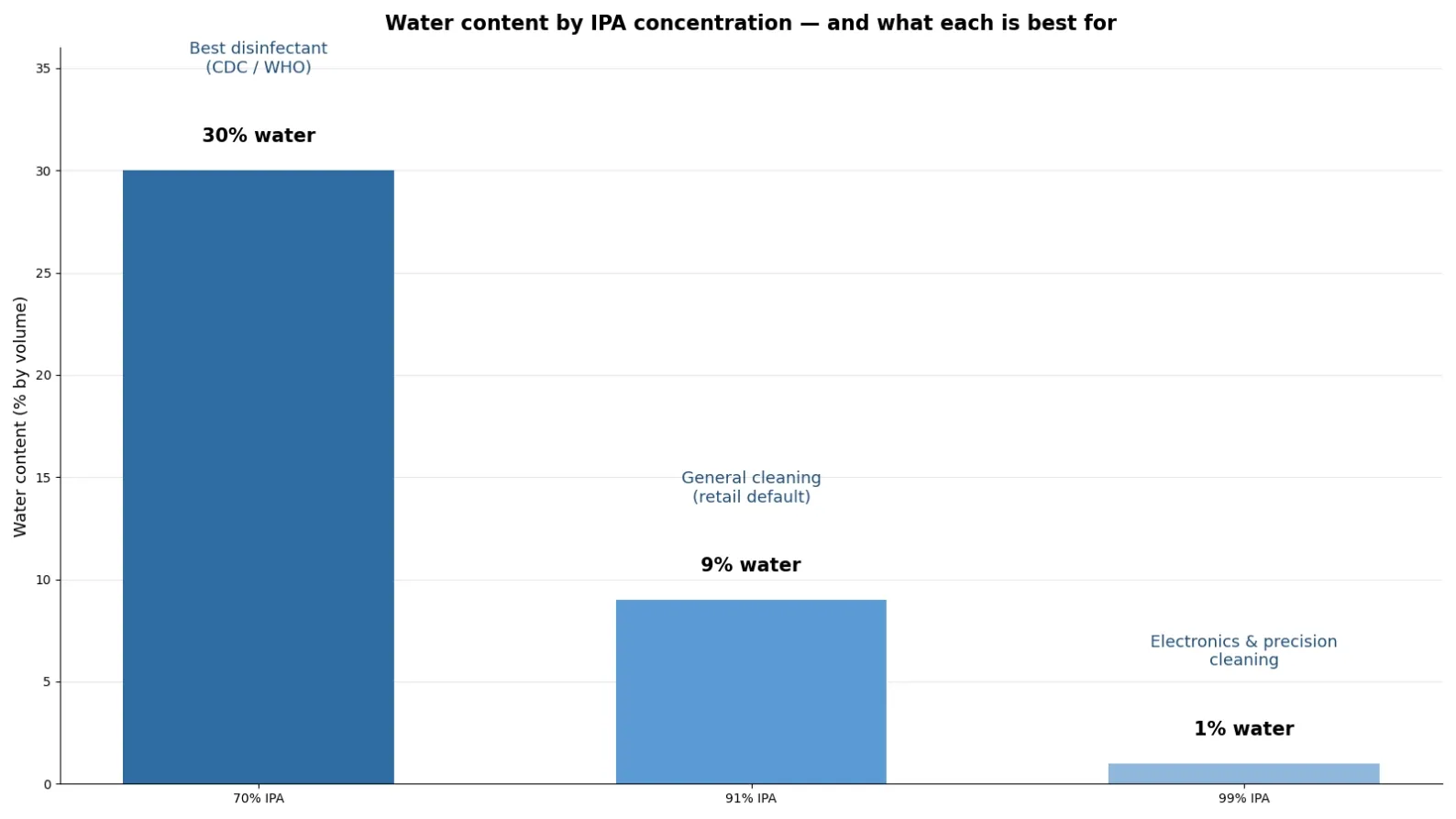
70% IPA is 30% water; 91% IPA is 9% water; 99% IPA is 1% water. The water is what makes 70% the better disinfectant — and what makes 99% the better electronics cleaner.
Why is 70% IPA a better disinfectant than 99%?
It seems counterintuitive, but the science is consistent across decades of research. Alcohol kills microorganisms by denaturing (destroying) their proteins — and water is part of that process. In a 70% solution, the water slows evaporation, so the alcohol stays in contact with the surface and has time to penetrate the microbial cell wall before the proteins coagulate. In a 99% solution, the alcohol evaporates so quickly that it can flash off before doing the same work, and the rapid contact can coagulate proteins on the cell surface into a protective barrier that shields the interior of the cell. The result: 70% IPA is the more effective surface disinfectant, and it is the concentration the CDC and WHO recommend for surface disinfection. The same logic applies to skin preparation and first aid — 70% is the standard in hospitals and clinics worldwide. Higher concentration is not higher performance here; it is the wrong tool for the job.
When do you need 99% IPA?
Whenever water is the enemy. On a printed circuit board, water left behind after cleaning can corrode contacts, leave ionic residue and cause short circuits — so PCB defluxing, electronics cleaning and precision optics demand an anhydrous solvent that evaporates cleanly and leaves nothing behind. The same applies to 3D printing (cleaning resin from parts), thermal paste removal, and laboratory cleaning of glassware and instruments, where a water spot or a residue film ruins the result. Yuandafeng's IPA is 99.9% industrial grade, which is the concentration these jobs need. Note that 99% is a poor disinfectant for the same reason it is a good cleaner: it evaporates before it can do the slow work of denaturing proteins. If a supplier tells you their 99% product is "stronger" for disinfection, they are selling the number, not the chemistry.
What do the grades mean — technical, USP, ACS, electronic?
Concentration (70%, 91%, 99%) and grade (technical, USP, ACS, electronic) answer two different questions: how much alcohol is in the bottle, and how pure and documented is it. Technical or industrial grade meets general commercial specifications and ships with an SDS and a spec sheet — right for cleaning, degreasing and general manufacturing. USP grade meets the United States Pharmacopeia monograph and ships with a Certificate of Analysis, which is what pharmaceutical, diagnostic and personal-care buyers need for vendor qualification. ACS grade meets American Chemical Society reagent specifications, with each lot verified against its COA — the grade analytical labs and QC departments specify for HPLC, spectroscopy and reagent work. Electronic or high-purity grade is controlled for very low non-volatile residue and trace impurities, for electronics and semiconductor cleaning. Two practical consequences: a 99% assay does not make a product USP grade, and a 70% solution can be USP grade if it meets the monograph. When you order, state both the concentration and the grade — "99.9% technical grade" and "99.9% ACS grade" are different products at different prices, and the COA is what proves which one arrived.
Can I dilute 99% IPA to 70% myself?
Yes — and it is the standard way to get a disinfectant from a 99.9% drum. Mix 7 parts of 99.9% IPA with 3 parts of purified water (distilled or deionised) by volume, which gives about 70%, then verify the result with a hydrometer or a refractometer matched to IPA. Use purified water, not tap water: minerals in tap water leave residue and can interfere with disinfection. Label the diluted batch with the concentration and the date, keep it in a closed, labelled container away from ignition sources, and do not keep large volumes of diluted disinfectant for months — make it in batches you will use. Two cautions. First, the dilution changes the hazard profile only slightly: the mixture is still flammable, with a flash point well below room temperature, so the same storage rules apply. Second, if you sell the diluted product as a disinfectant, check your local regulations — disinfectant claims are regulated in most markets, and a home dilution is for your own use, not for resale as a registered product.
How do I choose? (and what Yuandafeng supplies)
| Your job | Choose |
|---|---|
| Surface disinfection, healthcare, food processing, cleanrooms | 70% — the CDC/WHO recommendation |
| General cleaning, degreasing | 70% for disinfection, 91% or 99% for solvent cleaning |
| Electronics, PCB defluxing, precision optics, 3D printing | 99% / 99.9% — anhydrous, residue-free |
| Pharma or diagnostic use | USP grade, with COA — state the grade on the PO |
| Analytical lab, HPLC, QC | ACS grade, lot-verified COA |
| First order from a new supplier | Trial order; confirm grade, concentration and COA before a full container |
Buying in bulk: Yuandafeng supplies 99.9% IPA in 160 kg drums — dilute it to 70% for disinfection, or use it straight for electronics and precision cleaning, with a per-batch COA on request. One drum covers both jobs.
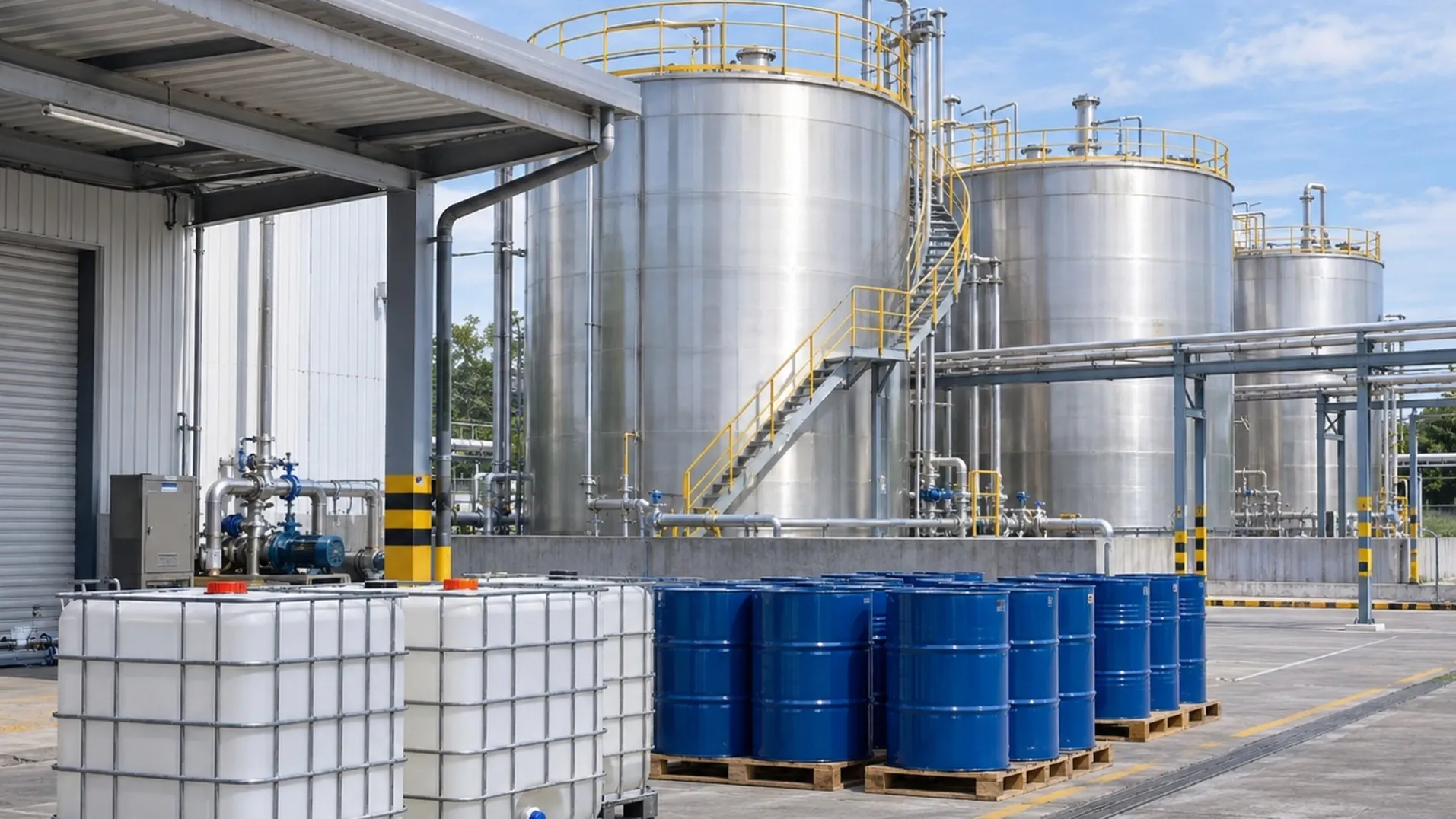
What Yuandafeng supplies: industrial-grade isopropyl alcohol 99.9% (CAS 67-63-0) in 160 kg drums, IBC totes and ISO tanks, with per-batch COA, SDS and TDS available on request. IPA ships as UN 1219, Class 3, Packing Group II — a highly flammable liquid — in UN-standard packaging with compliant dangerous-goods documentation. For disinfection use, dilute the 99.9% with purified water to about 70% as described above, or buy 70% ready-made. Samples are available on request to evaluate quality first. Yuandafeng is a trading company and licensed hazardous-chemical exporter, not a manufacturer.
View IPA product specifications
FAQ
Is 70% or 99% isopropyl alcohol better?
It depends on the job. 70% is the better surface disinfectant because the water extends contact time; 99% is the better solvent, cleaner and drying agent because it evaporates fast and leaves minimal residue.
Can I use 99% IPA as hand sanitizer?
Not as it is. 99% evaporates too quickly to disinfect skin effectively. Dilute it to about 70% with purified water for surface disinfection, and check the grade and local rules before any skin or personal-care use — industrial-grade IPA is a solvent, not a cosmetic product.
Does IPA kill viruses?
70% IPA is effective against a broad range of bacteria, enveloped viruses and fungi when the surface stays wet for the required contact time. It is not effective against bacterial spores, and disinfectant claims are regulated — follow the contact time and rules for your market.
Is IPA safe on all surfaces?
No. IPA attacks some plastics and rubber, and it is highly flammable (flash point 11.7 °C). Test on an inconspicuous area first, never use it near open flames or hot surfaces, and keep containers tightly closed in a cool, ventilated place.
How should I store IPA?
In a cool, well-ventilated, fireproof area, away from ignition sources and strong oxidants, in tightly closed containers. IPA is a Class 3 flammable liquid (UN 1219, PG II) — treat every drum, including a 70% dilution, as flammable.
How do I dilute 99.9% IPA to 70%?
Mix 7 parts of 99.9% IPA with 3 parts of purified water (distilled or deionised) by volume, which gives about 70%, then verify the result with a hydrometer or a refractometer. Use purified water, not tap water, and label the diluted batch with the concentration and the date. The full step-by-step is in "Can I dilute 99% IPA to 70% myself?" above.
What is 91% IPA for?
91% is the most common concentration sold in shops, and it comes from the IPA–water azeotrope (about 91% by volume). It is a middle ground: it dries faster than 70% and works for general cleaning, degreasing, glass and adhesive residue, but it is less reliable than 70% for disinfection — it evaporates faster and carries less water — and it leaves more water behind than 99%, so it is not the best choice for electronics or precision optics. Most industrial buyers are better served by 70% for disinfection or 99% for cleaning.
Methodology
Property data are from ICSC 0554 (isopropyl alcohol, July 2020): formula C3H8O, molecular weight 60.1, boiling point 83 °C, melting point −90 °C, density 0.79, vapour pressure 4.4 kPa at 20 °C, flash point 11.7 °C closed cup, auto-ignition 456 °C, explosive limits 2–12 vol%, UN 1219, Class 3, PG II. The oral LD50 in rats (~5,000 mg/kg) is from RTECS/Wikipedia records. Disinfection mechanism and the CDC/WHO 70% recommendation are as cited in the Texas-Chem IPA grades guide and corroborated by the RightPath, Azlok and isopropylalcohol.au guides. The 91% azeotrope composition (91% by volume, boiling point 80.37 °C) is from Wikipedia's isopropyl alcohol data. YDFChem product data (99.9%, 160 kg drum, UN 1219, Class 3, PG II, COA/SDS/TDS on request, samples on request) are from the Yuandafeng IPA product page.
Limitations
Evaporation and residue descriptions are qualitative comparisons from supplier guides, not laboratory measurements under a single test protocol. The 91% figure is the azeotropic composition by volume; commercial 91% products are labelled by volume. The 7:3 dilution ratio assumes volume mixing and should be verified with a hydrometer or refractometer — IPA–water mixtures contract slightly on mixing, so the result is approximate. Disinfectant efficacy depends on contact time, surface type and local regulation, and this article is not a substitute for a registered disinfectant label. LD50 values vary by study (oral rat ~5,000 mg/kg). No MOQ, lead time or price is stated because none is published for this product — all are confirmed in the quotation.
References
- ICSC 0554 — Isopropyl Alcohol (ILO/IPCS, July 2020)
- Texas-Chem — IPA Grades Explained: 70% vs 91% vs 99% vs USP
- RightPath — IPA Grades Explained: 70% vs 99%, USP vs Technical
- Azlok — Isopropyl Alcohol (IPA): Uses, Grades & Buying Guide
- isopropylalcohol.au — 70% vs 99% Isopropyl Alcohol: Which Should You Use?
- Wikipedia — Isopropyl alcohol (azeotrope 91% by volume; LD50 oral rat 5,000 mg/kg)