Ethylene Glycol Purity Grades: 99% vs 99.5% vs 99.9% — Which One Do You Need?
The number on the label — 99%, 99.5%, 99.9% — is only the assay, the percentage of ethylene glycol in the drum measured by gas chromatography. It is not the grade. A grade is the assay plus limits on everything else: water, diethylene glycol (DEG), iron, chloride, acidity, aldehydes, colour, and UV transmittance. Under China's GB/T 4649-2018, industrial grade requires EG ≥99.0% with iron ≤5.0 mg/kg, while polyester grade requires EG ≥99.9% with iron ≤0.10 mg/kg and UV transmittance at 220 nm ≥75%. Yuandafeng's EG is 99.8%: above industrial grade, below polyester grade — right for antifreeze, coolant, resins and general industrial use, but not a substitute for polyester-grade material in PET production. Before ordering, match the grade to your process, then read the whole COA, not just the assay line.
Key Findings
- The assay is not the grade. 99%, 99.5% and 99.9% describe the EG content only. The grade is set by the full impurity list — iron, DEG, water, chloride, acidity, aldehydes, colour and UV transmittance.
- GB/T 4649-2018 draws the line clearly. Industrial (first) grade: EG ≥99.0%, iron ≤5.0 mg/kg. Polyester (superior) grade: EG ≥99.9%, iron ≤0.10 mg/kg, UV transmittance at 220 nm ≥75%, at 275 nm ≥92%, at 350 nm ≥99%.
- 99.5% is a supplier specification, not a GB/T grade. It commonly appears as an antifreeze-grade minimum (for example in ASTM E1177 coolant-grade glycol), and 99.5% is not automatically USP or ACS grade — just as 99.9% is not automatically electronic grade.
- Yuandafeng EG at 99.8% fits industrial, antifreeze, coolant and resin uses. Polyester and PET production need ≥99.9% plus the UV transmittance limits — if that is your process, say so in the RFQ so the grade is confirmed before ordering.
- On the COA, the assay is the least informative line. DEG, water, iron, chloride, acidity and aldehydes are what cause a batch to fail in a real process — check them all.
Table 1 — GB/T 4649-2018: industrial grade vs polyester grade
| Item | Industrial grade (first grade) | Polyester grade (superior grade) |
|---|---|---|
| EG assay (GC) | ≥99.0% | ≥99.9% |
| Iron (Fe) | ≤5.0 mg/kg | ≤0.10 mg/kg |
| UV transmittance, 220 nm | Not specified | ≥75% |
| UV transmittance, 275 nm | Not specified | ≥92% |
| UV transmittance, 350 nm | Not specified | ≥99% |
| Other items covered | DEG, water, aldehydes, acidity, colour, ash, chloride | DEG, water, aldehydes, acidity, colour, ash, chloride |
Sources: GB/T 4649-2018 as cited in supplier COA data (ChemicalBook/Yujiang Chemical) and the GNEE ethylene glycol grades guide. UV limits for industrial grade are not stated in the sources used.
Table 2 — What to check on an EG certificate of analysis (typical limits from supplier TDS/COA examples)
| COA item | Typical limit | Why it matters |
|---|---|---|
| Assay (GC) | 99.5–99.9% min | Active glycol content |
| Water (Karl Fischer) | ≤0.05–0.08% | Accurate blending; side reactions in esterification |
| DEG content (GC) | ≤0.05–0.10% | Affects polyester polymerisation and coolant specs |
| Iron (Fe, ICP-MS) | ≤0.1 mg/kg | Polymer colour; inhibitor stability |
| Chloride (as Cl) | ≤0.5–1 ppm | Aluminium and solder pitting |
| Acidity (as acetic acid) | ≤10 mg/kg | Corrosion potential; inhibitor reserve |
| Aldehydes (as formaldehyde) | ≤8–30 mg/kg | Oxidation stability; polyester quality |
| Colour (Pt-Co / APHA) | ≤5–10 | Clean appearance; dyeing and branding |
| Ash | ≤10–50 mg/kg | Deposits and scale |
| UV transmittance, 220 nm | ≥70–75% | Required for polyester/fibre grade |
| Specific gravity (20–25 °C) | 1.11–1.116 g/mL | Identity check against the datasheet |
Limits vary by grade and supplier — these are typical values from antifreeze-grade TDS and ACS-grade COA examples, not a single standard. Always confirm against the specific product's COA.
Figure 1 — Minimum EG assay by grade
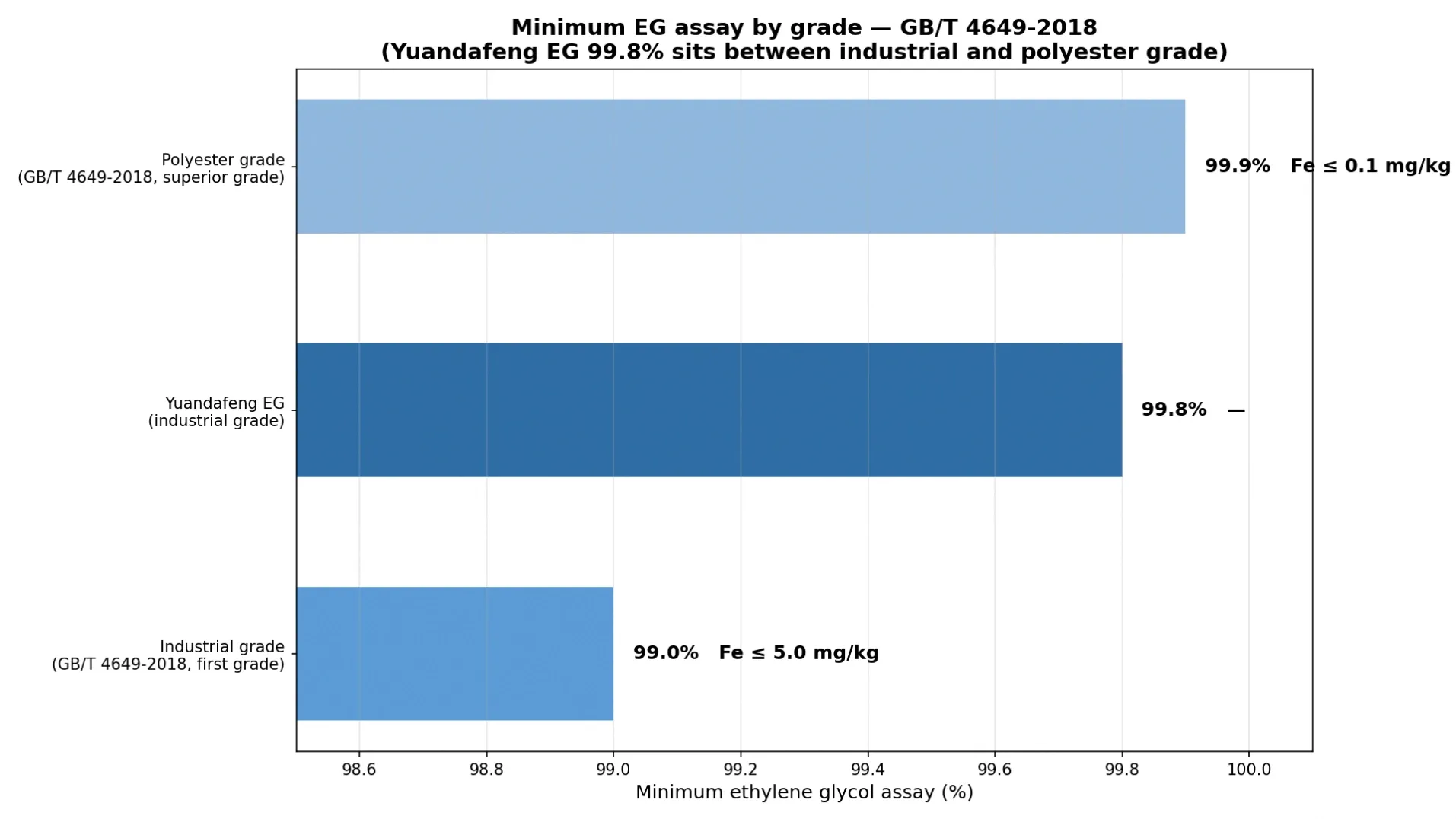
Figure 1 — Minimum EG assay by grade. Sources: GB/T 4649-2018 (industrial ≥99.0%, polyester ≥99.9%); Yuandafeng product specification 99.8%.
What do 99%, 99.5% and 99.9% actually mean?
They are assay values: the percentage of ethylene glycol in the material, usually measured by gas chromatography (GC). A drum labelled 99% contains about 1% of other things — mostly water and DEG, the co-product of ethylene oxide hydration, plus traces of aldehydes, acids and metals. At 99.9%, the "other things" shrink to 0.1%, and the limits on each impurity get much tighter. That is why two drums can both be "ethylene glycol" and behave differently in a reactor: the assay tells you how much glycol there is, but the impurity profile tells you what the rest will do to your process. Iron at 5 mg/kg will yellow a polyester chip; chloride at a few ppm will pit aluminium in a cooling loop; DEG above 0.1% will shift a polyester formulation. None of that shows in the headline number.
What does GB/T 4649-2018 require?
GB/T 4649-2018 is the Chinese national standard buyers meet most often when sourcing EG from China, and it defines two grades (Table 1). The first grade — the industrial grade — requires EG ≥99.0% and iron ≤5.0 mg/kg. The superior grade — the polyester grade — requires EG ≥99.9%, iron ≤0.10 mg/kg, and UV transmittance of ≥75% at 220 nm, ≥92% at 275 nm and ≥99% at 350 nm. Both grades also carry limits for DEG, water, aldehydes, acidity, colour, ash and chloride. The UV transmittance limits exist for a reason: they detect trace unsaturated impurities that a simple assay misses, and those impurities discolour polyester fibre. Note the 50-fold gap in the iron limit (5.0 vs 0.10 mg/kg) — that, more than the 0.9% assay gap, is what separates an industrial drum from a polyester drum.
What should I check on the COA besides the assay?
Work down Table 2. Water (Karl Fischer, typically ≤0.05–0.08%) matters because water throws off blending calculations and causes side reactions in esterification. DEG (GC, typically ≤0.05–0.10%) is the main by-product impurity and is limited in both coolant and polyester specifications. Iron (ICP-MS, ≤0.1 mg/kg for the tighter grades) controls polymer colour and coolant inhibitor stability. Chloride (≤0.5–1 ppm) pits aluminium and solder. Acidity (as acetic acid, ≤10 mg/kg) and aldehydes (as formaldehyde, ≤8–30 mg/kg) track oxidation and corrosion potential. Colour (≤5–10 Pt-Co/APHA) and ash (≤10–50 mg/kg) are quick visible checks. For polyester, add UV transmittance at 220 nm (≥70–75%). A COA that lists only the assay is not a COA — ask for the full item list, the batch number, and the test methods before accepting the shipment.
Is 99.8% enough for polyester?
Honestly: no, not as polyester grade. Polyester and PET production specify ≥99.9% together with the UV transmittance limits in Table 1, and a 99.8% assay does not meet that specification however good the rest of the COA looks. What 99.8% is right for is the large middle of the market: antifreeze and coolant formulations, heat-transfer fluids, unsaturated polyester resins, coatings, inks and general industrial use, where the industrial-grade limits apply and the tighter polyester limits are not needed. Buying 99.9% for a coolant loop is paying for purity the loop cannot use; buying 99.8% for a PET line is a batch that fails incoming inspection. The right question is never "which is better" but "which does my process specify" — then order that grade by name and number, and put the grade on the PO.
What Yuandafeng supplies
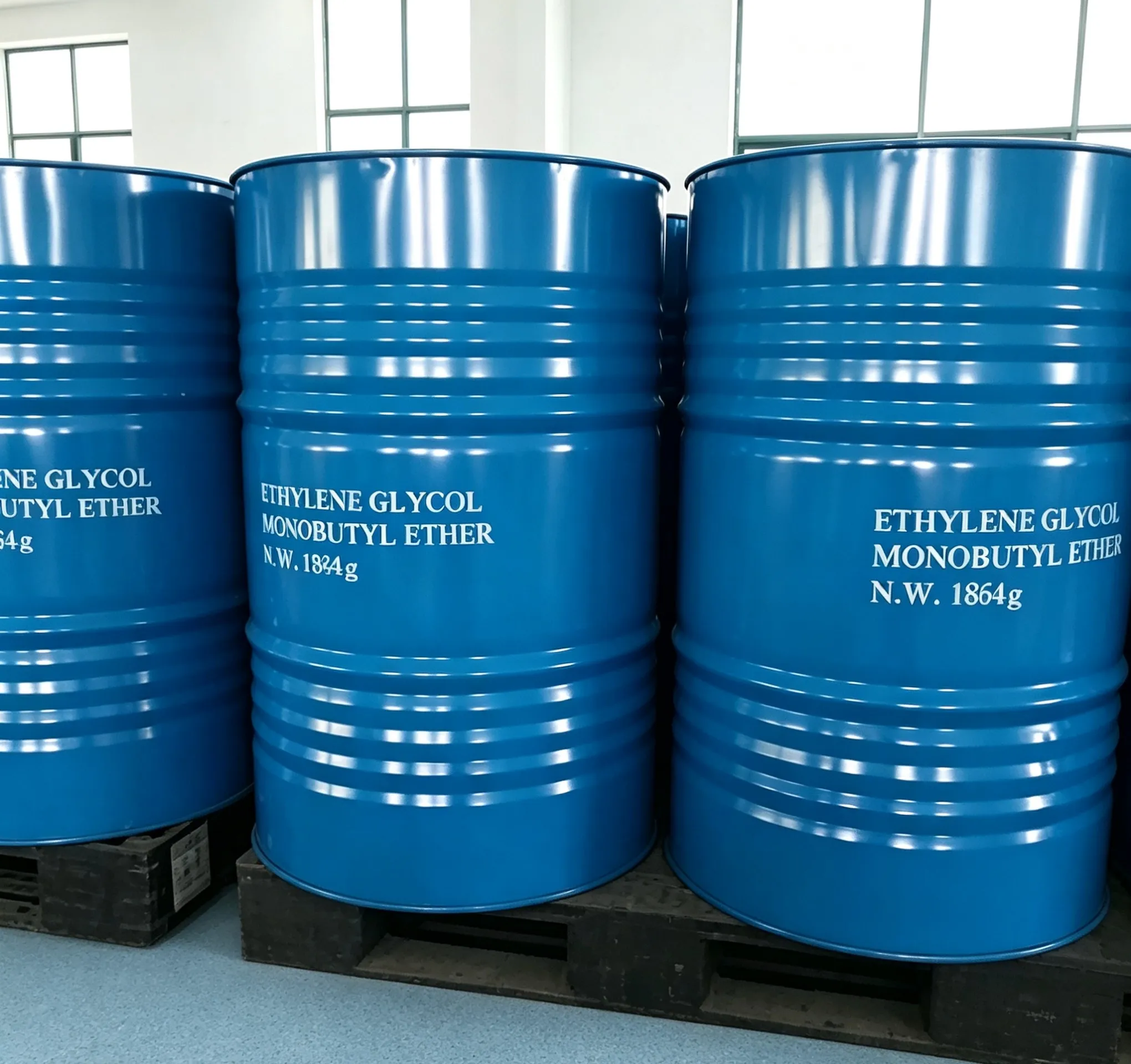
Yuandafeng supplies industrial-grade ethylene glycol 99.8% (CAS 107-21-1) in 230 kg drums, IBC totes and ISO tanks, with a per-batch COA, SDS and TDS available on request. EG ships as UN 3082, Class 9. If your process needs polyester grade (≥99.9% with UV transmittance), state it in the RFQ so the grade is confirmed before ordering — do not assume a 99.8% drum can be relabelled. Propylene glycol, diethylene glycol and triethylene glycol are also available from Yuandafeng; product pages are being added, so contact us for specifications in the meantime.
View Ethylene Glycol product specifications
FAQ
Is 99.9% ethylene glycol always better than 99%?
No. It is better for polyester and PET, where the specification demands it. For antifreeze, coolant and general industrial use, 99% or 99.8% industrial grade performs the same and costs less. Match the grade to the process.
What is the difference between industrial grade and polyester grade?
Under GB/T 4649-2018, industrial (first) grade requires EG ≥99.0% and iron ≤5.0 mg/kg; polyester (superior) grade requires EG ≥99.9%, iron ≤0.10 mg/kg, and UV transmittance ≥75% at 220 nm. The impurity limits, not just the assay, define the grade.
Does 99.5% mean USP grade?
No. 99.5% is an assay value, commonly used as an antifreeze-grade minimum. USP, ACS and electronic grades are separate specifications with their own impurity limits and test methods — an assay number alone does not confer them.
What if the COA shows DEG above 0.10%?
Discuss it with the supplier before accepting the batch. DEG above the limit affects polyester polymerisation and can breach coolant specifications. Do not blend it away silently — record the deviation and get written agreement.
How do I verify the assay on delivery?
Ask for the batch COA with the GC assay, batch number and test method before shipment, and compare it with the agreed specification on arrival. For a first order or a high-value shipment, a third-party test (SGS or BV) on a sample taken at loading is the independent check.
Methodology
Grade limits are from GB/T 4649-2018 as cited in supplier COA data (ChemicalBook/Yujiang Chemical batch COA) and the GNEE ethylene glycol purity grades guide, which states industrial grade EG ≥99.0% and polyester grade EG ≥99.9%, with iron ≤5.0 mg/kg industrial and ≤0.10 mg/kg polyester. Typical COA limits in Table 2 are compiled from an antifreeze-grade MEG technical data sheet (CausticSodaCo) and Alliance Chemical ACS-grade and semiconductor-grade typical COAs. Property data are from ICSC 0270 (May 2018).
Limitations
GB/T 4649-2018 has two grades (first/superior); other markets use different grade systems (ASTM E1177 EG-1/EG-2 for engine coolant grade; USP, ACS, electronic grades), so a percentage alone does not translate across systems. The Table 2 limits are typical values from supplier documents, not a single standard — the binding limits are the ones on your agreed specification and the batch COA. UV transmittance limits for industrial grade were not stated in the sources used.
References
- GNEE Chemical — Ethylene Glycol Purity Grades: 99% vs 99.5% vs 99.9% (GB/T 4649-2018 limits)
- CausticSodaCo — Antifreeze Grade MEG Supplier: specification and COA items (ASTM E1177)
- Alliance Chemical — Ethylene Glycol Inhibited ACS Grade, typical COA
- ICSC 0270 — Ethylene Glycol (ILO/IPCS, May 2018)
- ECHEMI — Ethylene Glycol CAS 107-21-1, industrial grade 99.9% specification
- ChemicalBook — Mono Ethylene Glycol, GB/T 4649-2018 batch COA (superior vs first grade)