n-Heptane vs n-Hexane: Should You Switch Your Extraction or Cleaning Solvent?
One carbon changes the toxicology, the drying time and the pharma limit. This comparison uses ICSC and NIST data to show when n-heptane is the right replacement — and when it is not a straight swap.
Key Findings
- One carbon changes the toxicology. n-Hexane is metabolised in the body to 2,5-hexanedione, a neurotoxin linked to peripheral neuropathy. n-Heptane is not. The NIOSH recommended limit is 50 ppm for n-hexane and 85 ppm for n-heptane.
- n-Hexane evaporates about 3.2 times faster at 30 °C (24.94 kPa vs 7.78 kPa) and boils 29 °C lower (69 °C vs 98.4 °C). Switching changes drying time and desolventising temperature — it is not a drop-in replacement.
- For pharmaceutical use the gap is even wider: under ICH Q3C, n-hexane is a Class 2 residual solvent (PDE 2.9 mg/day, 290 ppm), while n-heptane is Class 3 (PDE 50 mg/day, 5000 ppm) — about 17 times more headroom.
- Both are Class 3 flammable liquids (n-hexane UN 1208, n-heptane UN 1206, both Packing Group II). n-Heptane's flash point is higher (−7 °C vs −22 °C), but both flash below room temperature, so the fire rules do not change.
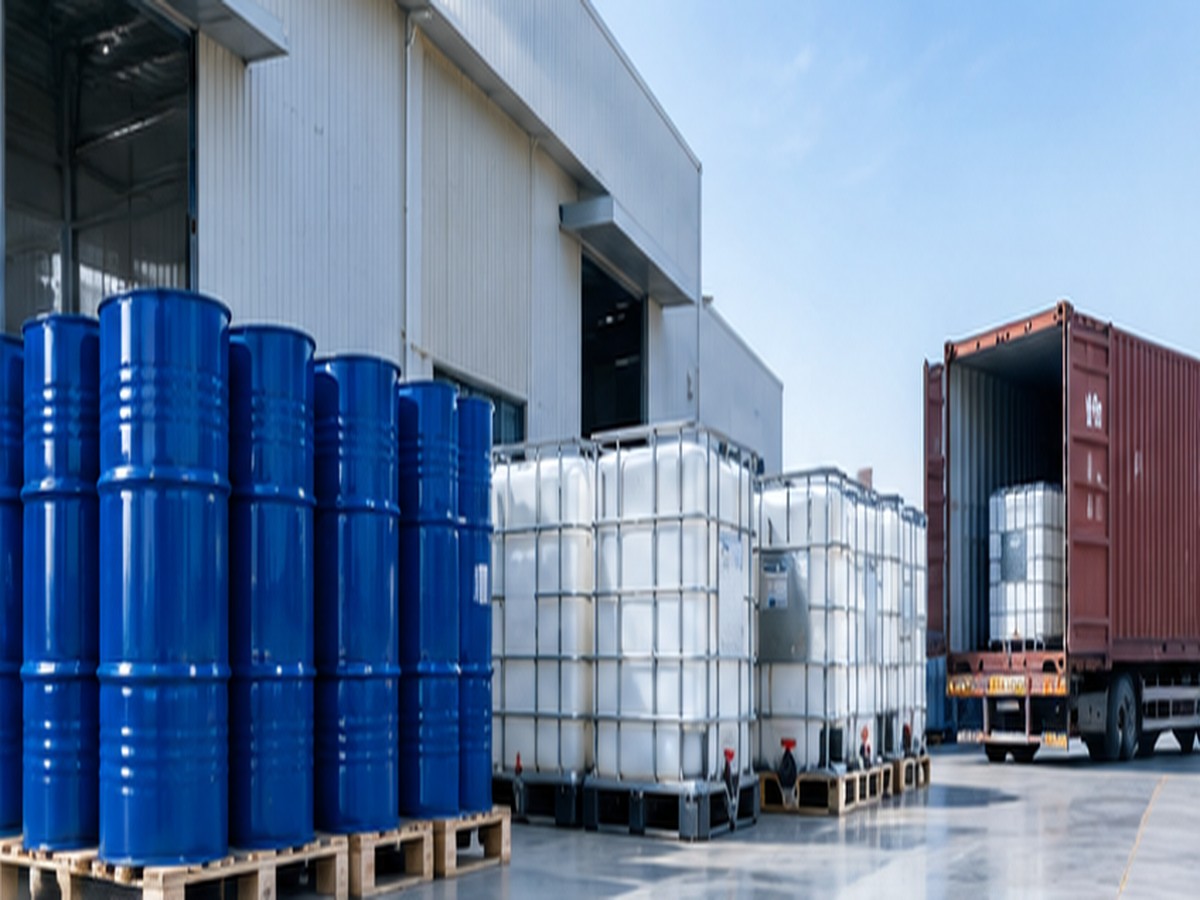
- Yuandafeng Chemical supplies n-heptane at 99.0% purity in 137 kg drums, IBC totes and ISO tanks. It does not supply n-hexane. Before switching, run a bench trial and check your residue specification — a customer or regulator may specify hexane by name.
Introduction
Should you replace n-hexane with n-heptane? For most extraction, cleaning and adhesive buyers the answer is yes — but not by simply pouring one solvent in place of the other. The two solvents look almost identical on a shelf: clear, colourless, non-polar alkanes, one carbon apart. In use they differ in three ways that decide the switch: how toxic they are to workers, how fast they dry, and what limit a pharmaceutical customer will accept. This guide compares them on published ICSC and NIST data so you can judge whether the switch fits your process — and what to test before you commit to it.
Why are buyers switching from n-hexane to n-heptane?
Conclusion: the switch is driven by worker health and pharmaceutical regulation, not by solvency — the two solvents dissolve almost the same things.
n-Hexane's problem is not what it does in the tank, it is what the body does with it. n-Hexane is oxidised in the liver to 2,5-hexanedione, which is thought to be the neurotoxic agent: chronic exposure — the kind that happens in an extraction facility or an adhesive factory over years — causes peripheral neuropathy, numbness and weakness in the hands and feet (IPCS Health and Safety Guide No. 59). n-Heptane is one carbon longer, is metabolised through a different pathway, and does not produce 2,5-hexanedione. That single metabolic difference is why the NIOSH recommended exposure limit for n-heptane (85 ppm) is higher than for n-hexane (50 ppm), and why n-hexane is listed as a hazardous air pollutant under the U.S. Clean Air Act.
The second driver is pharmaceutical regulation. Under ICH Q3C, n-hexane is a Class 2 residual solvent that must be limited (PDE 2.9 mg/day, 290 ppm), while n-heptane is Class 3, low toxic potential (PDE 50 mg/day, 5000 ppm). A pharmaceutical process that validates against the Class 3 number has far more room on batch release testing and stability validation than one tied to 290 ppm. That is why heptane has become the default non-polar solvent in modern extraction and crystallisation facilities.
How do the two solvents compare on hard data?
Conclusion: n-hexane is lighter, faster and more volatile; n-heptane is heavier, slower and less volatile. Everything else — flammability, water insolubility, non-polar character — is close.
Table 1. Reference properties (ILO/WHO ICSC 0657 for n-heptane, ICSC 0279 for n-hexane)
| Property | n-Heptane | n-Hexane |
|---|---|---|
| CAS No. | 142-82-5 | 110-54-3 |
| Formula | C7H16 | C6H14 |
| Molecular mass | 100.2 g/mol | 86.2 g/mol |
| EC No. | 205-563-8 | 203-777-6 |
| Boiling point | 98.4 °C | 69 °C |
| Melting point | −90.7 °C | −95 °C |
| Relative density (water = 1) | 0.68 | 0.7 |
| Water solubility | 2.2 mg/l at 25 °C (very poor) | 0.0013 g/100 ml at 20 °C (practically insoluble) |
| Vapour pressure at 20 °C | 4.6 kPa | 17 kPa |
| Flash point (closed cup) | −7 °C | −22 °C |
| Auto-ignition temperature | 220 °C | 225 °C |
| Explosive limits in air | 0.8–6.7 vol% | 1.1–7.5 vol% |
| Octanol/water partition coefficient (log Pow) | 4.66 | 3.9 |
| UN No. / Class / Packing Group | UN 1206 / Class 3 / PG II | UN 1208 / Class 3 / PG II |
| NIOSH recommended limit (TWA) | 85 ppm (440 ppm, 15-min ceiling) | 50 ppm |
| OSHA PEL (8-hr TWA) | 500 ppm | 500 ppm |
| ICH Q3C residual solvent class | Class 3 (PDE 50 mg/day, 5000 ppm) | Class 2 (PDE 2.9 mg/day, 290 ppm) |
Table 2. Vapour pressure from the NIST Antoine equation (P in bar)
| Temperature | n-Hexane | n-Heptane | Ratio |
|---|---|---|---|
| 30 °C | 24.94 kPa | 7.78 kPa | 3.2× |
| 40 °C | 37.26 kPa | 12.33 kPa | 3.0× |
| 50 °C | 54.04 kPa | 18.88 kPa | 2.9× |
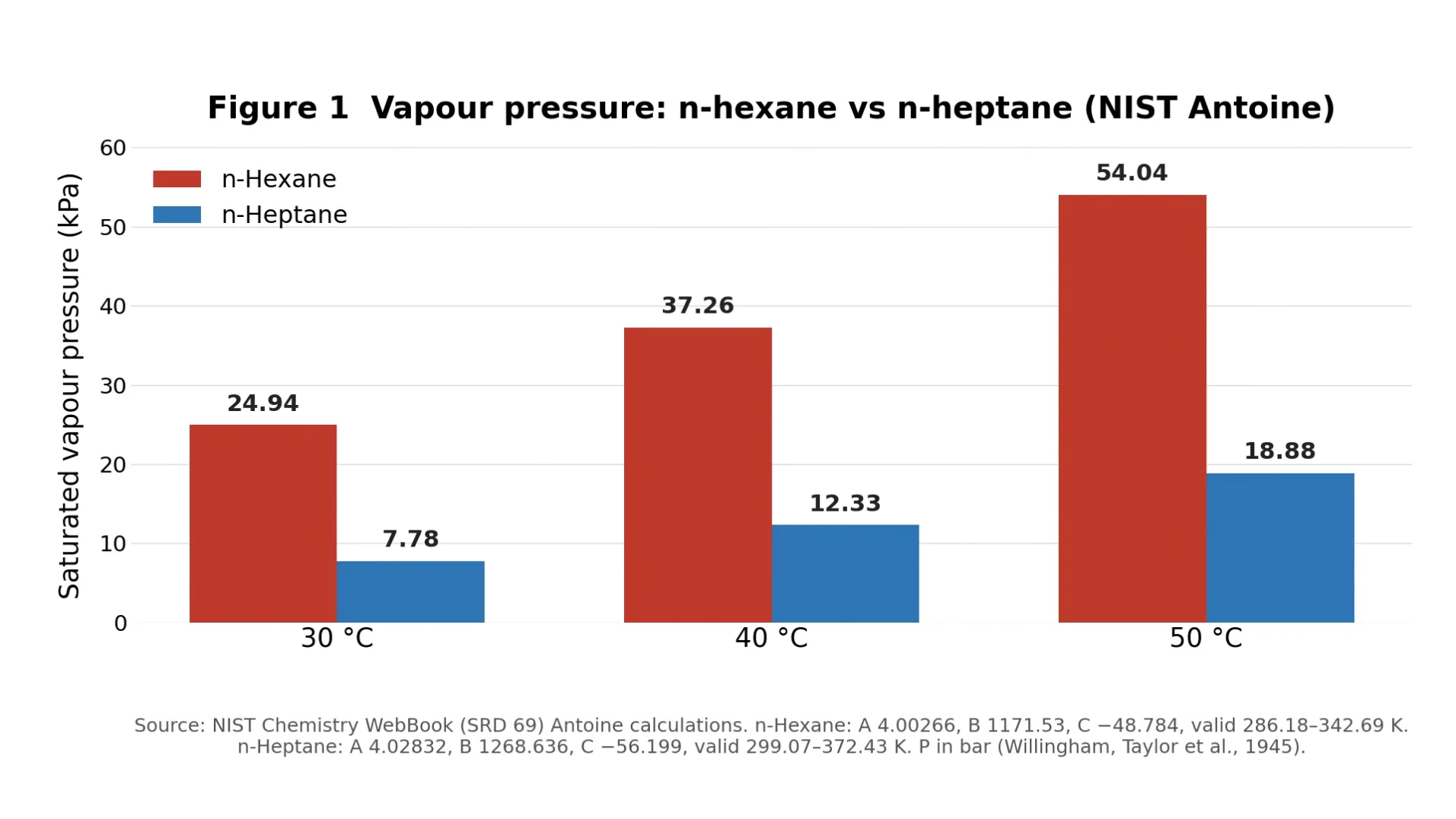
The gap narrows slightly as temperature rises, but n-hexane stays roughly three times more volatile across the whole range. The 20 °C ICSC values tell the same story: 17 kPa for n-hexane against 4.6 kPa for n-heptane, a ratio of about 3.7.
What does the switch cost you in drying time?
Conclusion: the switch costs drying speed. Budget for longer drying or more heat — and re-check your residue specification before you change a validated process.
n-Hexane's 29 °C lower boiling point is the reason it dries fast and strips easily from an extracted oil, an adhesive film or a cleaned part. n-Heptane's higher boiling point gives longer working time, which helps in adhesive application, but it needs more heat or vacuum to remove from a finished product. In extraction, desolventising temperature and residual-solvent results both shift. That is the practical trade-off behind the toxicology argument: you gain worker safety and regulatory headroom, and you pay for it in process time and energy.
Do not treat the switch as a blind swap. Run a bench trial on your own material, check the residue specification your customer or regulator actually tests against, and confirm that nobody in your chain specifies hexane by name — a specification that names n-hexane cannot be met with n-heptane, however similar the two solvents look. If your process is validated, re-validate the drying and residue steps on heptane before changing the bulk supply.
What do the regulations say?
Conclusion: every framework that matters to a buyer points the same way — heptane is the lower-restriction solvent — but the frameworks measure different things, so check the one your customer uses.
- ICH Q3C (pharma): n-hexane is Class 2, PDE 2.9 mg/day, 290 ppm. n-Heptane is Class 3, PDE 50 mg/day, 5000 ppm. If your customer tests residual solvent, this is usually the deciding number.
- Workplace exposure (NIOSH): recommended limit 50 ppm for n-hexane, 85 ppm for n-heptane. The OSHA permissible limits are the same for both (500 ppm, 8-hour TWA), so do not claim an OSHA difference that does not exist — the difference is in the NIOSH recommendation and in the chronic neurotoxicity behind it.
- Air emissions (U.S.): n-hexane is a hazardous air pollutant under the Clean Air Act, which adds reporting and emission-control work for users. n-Heptane is not listed the same way.
- A trap to check: petroleum ether 60–80 °C can contain 20–40% n-hexane by mass. If you validate a process against petroleum ether as a Class 3 mixture but do not separately test for residual n-hexane, you can pass on paper and fail on the stricter Class 2 number. Buyers switching to pure n-heptane remove that ambiguity entirely.
When should you choose each solvent?
Conclusion: choose n-heptane when health, regulation or a customer specification points that way; keep n-hexane only where fast stripping is specified and the residue limit allows it.
| Use | Choose n-heptane when | Keep n-hexane when |
|---|---|---|
| Vegetable oil and botanical extraction | You want the lower-toxicity solvent and your residue specification allows the slower desolventising | Your process is validated on hexane and the customer specifies it by name |
| Pharmaceutical extraction and crystallisation | ICH Q3C Class 3 headroom matters (5000 ppm vs 290 ppm) | A validated process or a pharmacopoeia monograph names hexane |
| Rubber and adhesive formulations | You want longer working time and lower worker exposure | You need the fastest possible flash-off from the film |
| Precision cleaning and degreasing | You need a residue-free, non-polar cleaner with lower vapour exposure | You need the fastest evaporation from the part |
| Laboratory and GC work | You need a non-polar solvent or an octane-reference standard — n-heptane defines the zero point of the RON and MON scales (ASTM D2699 / D2700) | A method specifies hexane as the solvent |
| Octane rating reference fuel | Always — n-heptane is the zero-octane reference | Not applicable |
Yuandafeng Chemical's n-heptane is used for vegetable oil and edible oil extraction, pharmaceutical and herbal extraction, rubber and adhesive formulations, precision hardware cleaning and polymerisation reaction media — the applications where the switch is already happening.
How to specify n-heptane when you order
Conclusion: specify grade, residue limit and packaging in the inquiry — the three things that decide whether the first shipment matches your process.
Send an inquiry that states the product name (n-heptane), CAS number 142-82-5, the purity you need (Yuandafeng Chemical supplies 99.0%), the packaging (137 kg drums, IBC totes or ISO tanks), the quantity, the destination port, and any residue or test limit your process requires. Ask for the current COA and SDS for the batch in the quotation, and confirm the UN 1206 / Class 3 / PG II dangerous-goods documentation before the container ships. If you are switching from n-hexane, say so in the inquiry and attach your bench-trial result or your residue specification — it lets the supplier confirm the grade fits before the first drum leaves, instead of after it arrives.
View n-Heptane product specifications — CAS 142-82-5, 99.0%, UN 1206, 137 kg drums. For the six-solvent volatility comparison behind this article, see Which Industrial Solvent Is More Volatile? Six Chemicals Compared Using NIST Data.
Frequently asked questions
Can n-heptane replace n-hexane one to one?
No — not without a trial. The solvency is close, but n-heptane boils 29 °C higher and evaporates about three times slower at 30 °C, so drying time, desolventising temperature and residual-solvent results all shift. Run a bench trial and check your residue specification first.
Is n-heptane non-toxic?
No. "Safer than n-hexane" is not the same as safe. n-Heptane is a highly flammable liquid (flash point −7 °C), may be fatal if swallowed and enters airways, may cause drowsiness or dizziness, and is very toxic to aquatic life. What it does not do is produce the neurotoxic 2,5-hexanedione metabolite that makes chronic n-hexane exposure dangerous. Handle it with the same fire and ventilation discipline as any Class 3 flammable liquid.
Which solvent evaporates faster?
n-Hexane, by about three times. At 30 °C the vapour pressures are 24.94 kPa for n-hexane and 7.78 kPa for n-heptane (NIST Antoine). At 20 °C the ICSC values are 17 kPa and 4.6 kPa.
What does ICH Q3C say about the two solvents?
n-Hexane is Class 2: PDE 2.9 mg/day, concentration limit 290 ppm. n-Heptane is Class 3: PDE 50 mg/day, concentration limit 5000 ppm. For pharmaceutical buyers that is usually the deciding difference.
How is n-heptane shipped?
As a dangerous good: UN 1206, Class 3, Packing Group II, in 137 kg drums, IBC totes or ISO tanks with UN-standard packaging and DG documentation. FCL and LCL are available depending on product and destination. Confirm the DG declaration and the destination-country entry requirements at the quotation stage.
How this guide was made (Methodology)
All physical-property values in Table 1 are reference values from the ILO/WHO International Chemical Safety Cards: ICSC 0657 for n-heptane (June 2015) and ICSC 0279 for n-hexane (April 2024). The vapour-pressure values in Table 2 and Figure 1 were calculated from the NIST Chemistry WebBook (SRD 69) Antoine equations — n-hexane A 4.00266, B 1171.53, C −48.784, valid 286.18–342.69 K; n-heptane A 4.02832, B 1268.636, C −56.199, valid 299.07–372.43 K; P in bar; source data Willingham, Taylor et al., 1945. The n-heptane 30 °C value (7.78 kPa) matches the value already published in our companion article "Which Industrial Solvent Is More Volatile? Six Chemicals Compared Using NIST Data". The neurotoxicity mechanism is taken from IPCS Health and Safety Guide No. 59 (n-Hexane, 1991). Exposure limits are from the NIOSH Pocket Guide and OSHA; the ICH Q3C classes and limits are from ICH Q3C Table 2 (Class 2) and Table 3 (Class 3). Purity, packaging and applications for n-heptane are taken from Yuandafeng Chemical's own n-heptane product page. No new laboratory tests were conducted for this article, and no values were measured by Yuandafeng Chemical.
Research limitations
- The ICSC and NIST values are published reference values, not batch measurements. A batch COA governs acceptance for any specific shipment.
- Vapour-pressure values vary slightly by source and method. Table 1 uses the ICSC values at 20 °C (n-hexane 17 kPa, n-heptane 4.6 kPa); Table 2 uses NIST Antoine values from 30 °C upward (the Antoine calculation gives 16.16 kPa for n-hexane at 20 °C, close to the ICSC value of 17 kPa). Flash-point values in published SDSs vary by test method (n-hexane: ICSC −22 °C closed cup; other sources −21.7 °C to −26 °C. n-Heptane: ICSC −7 °C closed cup; other sources −4 °C). The value on the shipment's SDS governs handling.
- The comparison describes pure n-hexane and pure n-heptane. Commercial "hexane" is often a mixture of isomers, and petroleum ether cuts vary in n-hexane content — check the composition on the SDS of the material actually supplied.
- Regulatory summaries in this article are for buyer orientation. The ICH Q3C limits should be confirmed against the current official text and the shipment's SDS before ordering.
- Prices, lead times, MOQ and stock availability change with the feedstock market and are confirmed per quotation, not in this article.
Request a quotation
Send an inquiry that includes the product name (n-heptane), CAS number 142-82-5, the purity you need (99.0%), estimated quantity, preferred packaging such as 137 kg drums, your residue or test limit if you are switching from n-hexane, and your destination port. Email annie@ydfchem.com or contact us on WhatsApp at +86 156 8428 8875. Our sales team will confirm availability and respond with a supply plan matched to your requirement, including a delivery schedule if this is a recurring volume. You can also reach us through our Contact Us page.
References
- ILO/WHO International Chemical Safety Card ICSC 0657 — n-Heptane (CAS 142-82-5). https://chemicalsafety.ilo.org/dyn/icsc/showcard.display?p_card_id=0657&p_version=1&p_lang=en
- ILO/WHO International Chemical Safety Card ICSC 0279 — n-Hexane (CAS 110-54-3). https://chemicalsafety.ilo.org/dyn/icsc/showcard.display?p_lang=en&p_card_id=0279
- NIST Chemistry WebBook, SRD 69 — n-Heptane (CAS 142-82-5), Antoine Equation Parameters. https://webbook.nist.gov/cgi/cbook.cgi?ID=C142825&Units=SI&Mask=FFF&Type=ANTOINE&Plot=on
- NIST Chemistry WebBook, SRD 69 — n-Hexane (CAS 110-54-3), Antoine Equation Parameters. https://webbook.nist.gov/cgi/cbook.cgi?ID=C110543&Units=CAL&Mask=4
- IPCS Health and Safety Guide No. 59 — n-Hexane (2,5-hexanedione as the neurotoxic metabolite). https://inchem.org/documents/hsg/hsg/hsg059.htm
- ICH Q3C — Impurities: Guideline for Residual Solvents (n-hexane Class 2, PDE 2.9 mg/day, 290 ppm; n-heptane Class 3, PDE 50 mg/day, 5000 ppm). https://www.ich.org/page/multidisciplinary-guidelines
- Yuandafeng Chemical — n-Heptane product page (99.0%, UN 1206, PG II, 137 kg drums). https://www.ydfchem.com/products/n-heptane
- Yuandafeng Chemical — "Which Industrial Solvent Is More Volatile? Six Chemicals Compared Using NIST Data" (n-heptane 30 °C vapour pressure 7.78 kPa). https://www.ydfchem.com/posts/industrial-solvent-vapor-pressure-comparison